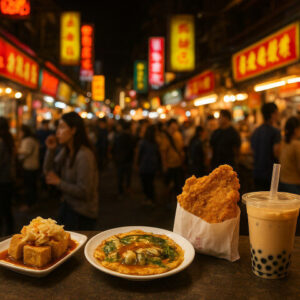
This 300-kilometer journey is far more than a spiritual trek; it is a “moveable feast” of human compassion. In this 2026 Mazu Pilgrimage Food Guide, we explore how the food found along the path isn’t just about sustenance—it’s a living philosophy of restraint, gratitude, and celebration. On this trail paved with incense smoke and firecracker red, you will never go hungry. But remember: you aren’t just eating a meal; you are participating in a rare, raw trust between strangers that defines the Taiwanese spirit.

Mazu Pilgrimage Food Stations: The Outbound Purity
When the Goddess Mazu begins her journey south, a sense of disciplined solemnity fills the air. During these first few days, the Mazu Pilgrimage food stations are strictly vegetarian. I remember a massive station at the Changhua border: a dozen high-pressure stoves lined up, with giant pots of vegetable congee and stir-fried noodles bubbling away. The ladies running the kitchen might have a combined age of 500 years, but they move with the precision of a Swiss watch.
This is “logistical tenderness.” Here, eating vegetarian is a collective “body detox.” Volunteers at these large stations aren’t just providing snacks; they are the backbone of the pilgrimage, ensuring that tens of thousands of people can walk toward the divine with a light heart and a clear mind. That bowl of plain rice porridge has no fancy seasoning, only pure reverence. It makes your body feel light and your spirit feel steady.
The Return Journey: A Celebration of Street Food
Everything changes once Mazu turns back home. The air shifts from solemn to celebratory. You’ll start to smell the sizzle of fat on a hot grill—the “meat ban” is officially lifted! The focus shifts from organized mega-tents to spontaneous, individual roadside stalls.
You might see a small blue truck with a charcoal grill flipping succulent sausages, or a family serving big bowls of golden Sesame Oil Chicken soup right in front of their house. These stalls often come from personal stories of gratitude—perhaps a thank-you to the Goddess for a family member’s recovery or a child’s graduation. When you take that steaming plate, you’re consuming a family’s blessing. In the exhaustion of the return journey, these meat dishes are a reward for your body and a celebration of a mission accomplished.

How to Identify Free Food Stations in the 2026 Mazu Pilgrimage
For international travelers and first-time pilgrims, it can be confusing: Is this food a gift, or a business? The secret to navigating the 2026 Mazu Pilgrimage Food Guide lies in the details of the interaction:
- Check the Keywords: Look for signs saying “Jie Yuan” (結緣 – forming a bond), “Ping An” (平安 – Peace/Safety), or “Free Supply.” These are usually written on simple red paper with humble handwriting. In contrast, commercial stalls will have professional, printed signs with clear prices.
- The Proactive Vibe: Volunteers at free stations will actively search for tired pilgrims. They’ll wave you down, shouting, “Come! Have some water, eat some watermelon before you go!” A business stall maintains a professional distance, waiting for you to walk up and order.
- The Magic Words: A vendor asks, “What would you like to eat?” A volunteer says, “Xinku le!” (You’ve worked hard!). When you hear “Xinku le,” you know it’s a gift of kindness. The “price” isn’t money; it’s your heartfelt “Thank you.” This is the most authentic identification tag of pilgrimage food.
FAQ: Navigating the Rituals of Mazu Food
Q1: Why is there a tradition of “Eating Vegetarian” on the way out and “Meat” on the way back?
A: Going vegetarian (Outbound) is a sign of respect to the Goddess and a way to purify the body and mind. It helps pilgrims stay focused and calm during the long trek. Switching to meat (Inbound) signifies “Completion.” Once the main ritual is finished, the meat ban is lifted to celebrate the successful spiritual journey and to replenish the body’s energy for the walk home.
Q2: Is the food at the stations really free? Can I take it even if I’m not a religious devotee?
A: Yes! These stations are funded by donations or individuals fulfilling vows. Everyone—including international tourists—is welcome. However, it is not “charity” in the traditional sense; it is a “transfer of peace.” Please take only what you can eat, avoid waste, and always offer a sincere “Thank you” (or “Gan-en” in Taiwanese).
Q3: Are there fixed times for these food stalls?
A: Large stations near major temples or intersections are usually very stable and serve food for long hours. Roadside family stalls are “magical surprises”—they appear when the family is ready and disappear once the food runs out. This unpredictability is part of the charm of the pilgrimage.
Conclusion: The Invisible Contract of Compassion
In modern cities, we are used to calculated exchanges—paying for what we get. But on the Mazu Pilgrimage, that logic fails. From the disciplined vegetarian stations to the warm roadside meat treats, these two different food scenes weave together the resilience of Taiwanese society. True wealth isn’t about expensive ingredients; it’s the willingness to split your last piece of bread with a stranger and say, “You’ve worked hard. Eat your fill before you keep going.” This invisible contract of compassion is what makes the 2026 Mazu Pilgrimage a journey every traveler should experience at least once.